Appendix D: The Biology Behind It
Copy all the text on this page. Paste it into any AI — Claude, ChatGPT, Copilot, or any other. Then type:
The genome: not a blueprint but a regulatory network
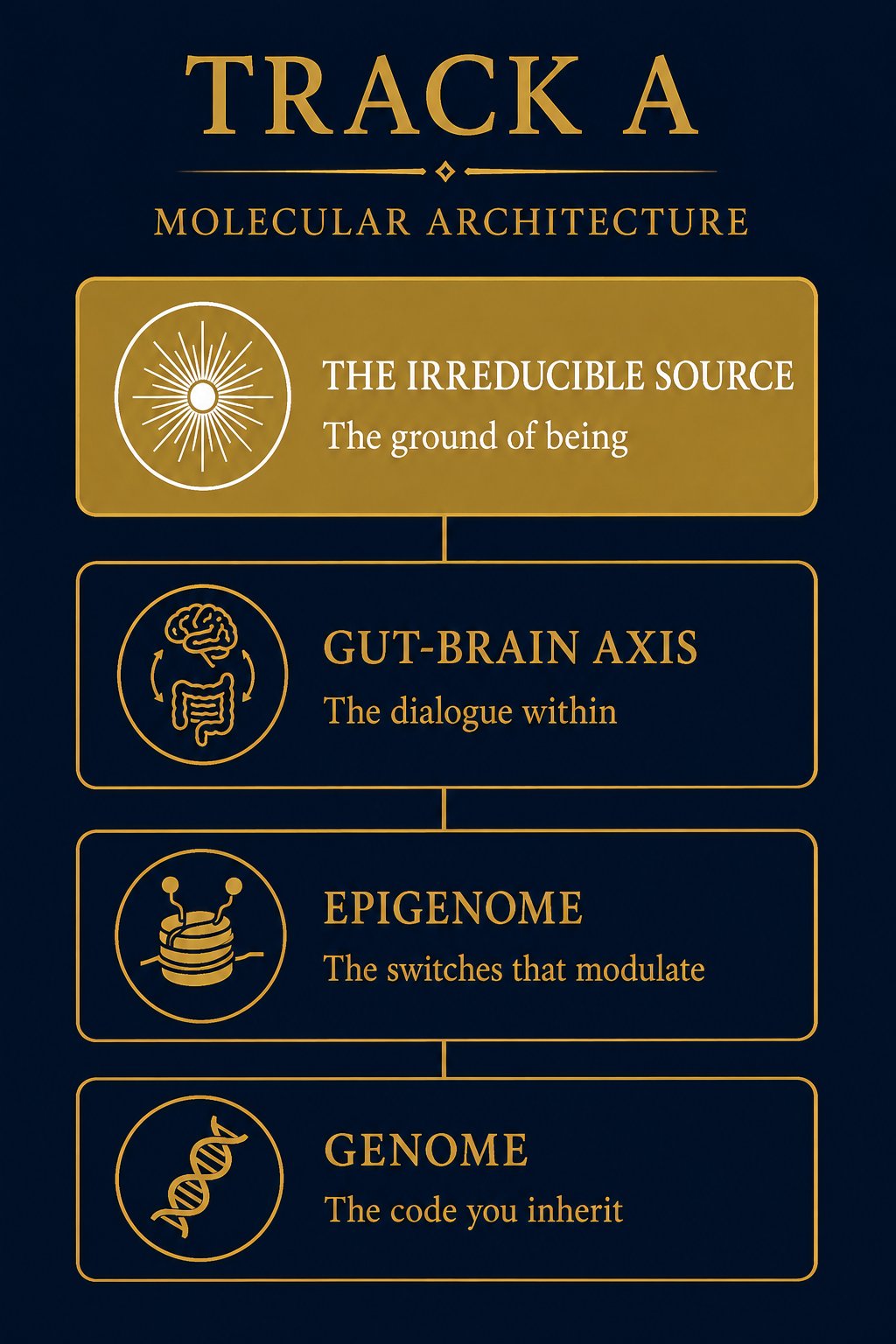
Chapter 4 describes the genome as a biological code assembled across generations. That description is accurate but incomplete. The genome is more precisely understood as a vast regulatory network – approximately 3.2 billion base pairs in the human haploid genome, encoding about 20,000 protein-coding genes that collectively represent less than two per cent of the total sequence. The remainder, long dismissed as junk DNA, is now understood to contain regulatory elements of considerable functional importance: enhancers, silencers, insulators, and non-coding RNAs that govern when, where, and to what degree protein-coding genes are expressed.
This matters for the book’s argument because it means the genome is not a static instruction set. It is a dynamic regulatory architecture whose outputs depend critically on what is reading it and how. The same sequence, read under different epigenetic conditions, produces different biological outcomes. The genome is the library. But the library has a complex internal architecture – some books in restricted collections, others in open stacks, the arrangement shifting continuously in response to signals from inside and outside the cell.
The heritable component of this complexity is substantial. Genome-wide association studies (GWAS) have identified thousands of single nucleotide polymorphisms (SNPs) associated with variation in cognitive traits – executive function, working memory capacity, processing speed, susceptibility to particular patterns of stress response. Individual SNPs account for small fractions of variance. Polygenic scores – aggregating the effects of thousands of variants – are more informative but still explain a minority of total heritability for most complex cognitive traits. The gap between measured heritability and genetically explained variance, sometimes called missing heritability, remains one of the most active areas in molecular genetics. Part of the explanation lies in the epigenome.
DNA methylation: the primary epigenetic mechanism
The epigenome operates through several distinct molecular mechanisms. The most extensively studied is DNA methylation – the addition of a methyl group (CH₃) to the five-carbon position of cytosine residues, predominantly at CpG dinucleotides. Human DNA contains approximately 28 million CpG sites. Methylation is catalysed by DNA methyltransferase enzymes – DNMT1, which maintains methylation patterns during cell division, and DNMT3A and DNMT3B, which establish new methylation marks de novo.
Methylation at promoter-associated CpG islands is generally associated with transcriptional silencing, operating through two pathways: direct interference with transcription factor binding, and recruitment of methyl-binding proteins that recruit histone-modifying complexes, compacting the chromatin and rendering it inaccessible to the transcriptional machinery. Demethylation occurs through both passive and active pathways. Active demethylation involves the TET family of enzymes, which iteratively oxidise 5-methylcytosine through a series of intermediates ultimately resolved by base excision repair. The balance between methylation and demethylation at any given genomic locus is a dynamic equilibrium, sensitive to cellular signalling, metabolic state, and environmental input.
Histone modification: the second layer
DNA methylation operates in concert with histone modification. The 147 base pairs of DNA wrapping each nucleosome are subject to a complex array of post-translational modifications at the histone tail residues. These include acetylation, methylation, phosphorylation, ubiquitination, and SUMOylation, each catalysed by specific enzymatic machinery and each producing distinct functional consequences. Histone acetylation, catalysed by histone acetyltransferases and reversed by histone deacetylases, is broadly associated with transcriptional activation. Histone methylation is more contextually variable: trimethylation of H3K4 marks active promoters; trimethylation of H3K27, catalysed by the Polycomb Repressive Complex 2, marks stable transcriptional silencing; trimethylation of H3K9 marks constitutive heterochromatin – regions remaining permanently condensed and transcriptionally silent. The number of possible combinations of these modifications at any one point in the genome makes this system of control extremely complex.
Transgenerational epigenetic inheritance: the molecular controversy
The central problem is epigenetic reprogramming – the erasure of most epigenetic marks at two developmental stages. The first wave occurs in the primordial germ cells between weeks four and nine of human embryonic development, with methylation levels falling from approximately 70 per cent to below five per cent at most CpG sites. The second wave occurs immediately after fertilisation, when the paternal genome undergoes rapid active demethylation within hours of sperm-egg fusion. The controversy is over how much escapes.
Several categories resist full reprogramming consistently. Imprinted genes maintain their methylation marks through both reprogramming events via specialised mechanisms involving DNMT1 and imprinting control regions. Certain repetitive elements retain partial methylation. A small but reproducibly identified subset of non-imprinted CpG sites shows consistent parental transmission of methylation state across generations. The Caenorhabditis elegans model has been most informative mechanistically. Small RNA molecules – particularly piRNAs loaded into sperm – can transmit epigenetic information across multiple generations by directing histone H3K9me3 marks to specific genomic loci in offspring. The machinery exists. The question for human biology is which components of analogous machinery are present and functional. Recent work has begun to identify specific mechanisms. A 2015 study in Cell of the developing human germline identified regions that resist the general resetting of DNA methylation, although their role, if any, in passing a parent’s experience to a child remains unestablished. A 2023 study in Cell followed deliberately introduced methylation changes in mice across generations: the methylation was reset and then re-established, not simply preserved, and an inherited metabolic trait followed.
The Holocaust survivor data has been both influential and contested. The original 2016 Yehuda et al. study identified differential methylation of the FKBP5 gene – which regulates glucocorticoid receptor sensitivity and therefore the cortisol stress-response system – in the offspring of Holocaust survivors, correlated with parental PTSD status. Replication attempts have produced mixed results. The replication difficulties may mean the effect is context-dependent, sensitive to factors including the timing, severity, and type of parental trauma, the sex of the transmitting parent, and the sex of the offspring, or that the original finding does not hold. The question is open.
What genetic genealogy reveals – and what it cannot
The commercial genetic genealogy industry has tested more than 40 million people worldwide as of 2025. Ancestry composition estimates provide statistically reliable information about the broad geographic origins of a person’s genetic lineage. Relatedness detection identifies relatives to the third or fourth cousin with high accuracy. Haplogroup assignment traces the direct maternal and paternal lines deep into human prehistory. All of this is sequence information. It describes the genome – the library. It does not and cannot describe the epigenome – the state of the library across the generations that preceded you.
Commercial genotyping arrays interrogate between 500,000 and 900,000 specific positions in the genome – approximately 0.03 per cent of the total sequence. They do not measure DNA methylation. They do not measure histone modification state. They measure sequence, not regulation. To profile the methylome requires bisulphite sequencing, which converts unmethylated cytosines to uracil while leaving methylated cytosines intact. Whole-genome bisulphite sequencing provides the most comprehensive methylome profile currently available. It measures the methylome of the cells sampled at the moment of sampling – not the methylome of the cells of previous generations, which no longer exist as living tissue.
This is the fundamental limit. The genealogist can tell you that your great-grandmother came from a village in Lithuania that experienced famine in the 1870s. The geneticist can tell you which haplogroup connects you to her maternal line. The epigenome researcher can tell you that you carry methylation patterns at specific stress-response loci statistically associated with ancestral trauma exposure. None of them can reconstruct the chain of biological causation from that village to your cells – because the intermediate biology is gone. The biological inputs to the irreducible brain are present in the body. Their generational history is not present anywhere. It lived in cells that no longer exist. The source is irreducible not merely because it is biological but because it is historical in a way that leaves no external record.
Learned behaviourisms: the pattern layer
Chapter 2 calls this Layer 3, the layer of skill, habit, and pattern recognition built up through repetition and experience. It sits below the gut-brain axis and above the epigenome in the sequence, and it is the layer where the distinction between human and machine is least sharp, because it is also the layer AI is built to be strongest at.
Neurologically, this layer is substantially the domain of procedural memory and cortical pattern consolidation. Repeated exposure to a class of problem strengthens synaptic pathways through long-term potentiation, and with sufficient repetition, tasks that initially require conscious, effortful attention become automatic, shifting from prefrontal-dependent control to more efficient basal ganglia and cerebellar circuits. This is the same mechanism, at the neural level, that produces expert pattern recognition in any domain, a chess grandmaster’s board sense, a radiologist’s eye for an anomaly, a tailor’s feel for a fault in cloth.
The defining feature of this layer, for this book’s argument, is that it is observable from the outside. The behaviour it produces, correct answers on familiar problems, fluent recall, fast recognition of known patterns, is visible, and in most domains, measurably scoreable. That is the property that makes it copyable. A sufficiently large model, trained on a sufficiently large corpus of examples, can approximate this same pattern-completion capacity without possessing anything like the biological substrate that produces it in a person. It does not need long-term potentiation to output a fluent answer to a familiar type of question, because the pattern it needs to complete already exists, at scale, somewhere in its training data.
This is well-established cognitive and neuroscientific territory, not a contested claim. Where the debate lies is not whether this layer exists or whether it can be modelled statistically, both are settled, but in how much of what people commonly call “intelligence” or “expertise” actually lives at this layer alone, versus how much depends on the layers above it, discussed next.
The gut-brain axis: the molecular detail
The enteric nervous system contains between 200 and 600 million neurons – more than the spinal cord – organised into two ganglionated plexuses running the length of the gastrointestinal tract: the myenteric plexus, which regulates gastrointestinal motility, and the submucosal plexus, which regulates fluid exchange and local blood flow. The primary ascending pathway is the vagus nerve, carrying approximately 80 to 90 per cent of its fibres from gut to brainstem, terminating in the nucleus tractus solitarius, which projects to the parabrachial nucleus, the hypothalamus, the amygdala, and the insula cortex.
The insula is the primary interoceptive cortex. Its anterior portion integrates interoceptive signals with emotional and cognitive processing, giving rise to somatic markers – the bodily feelings that accompany and inform decision-making. António Damásio’s somatic marker hypothesis, first proposed in 1991, proposes that this insula-mediated integration constitutes the neurobiological substrate of what is experienced as intuition. This remains contested rather than settled. Damásio’s original patient studies, in people with damage to the ventromedial prefrontal cortex, found intact abstract reasoning alongside impaired real-world decision-making, attributed to a missing bodily signal. Some researchers have argued since that these patients retained more conscious awareness of their own deficit than the theory’s account allows, which would locate the problem elsewhere. Separately, gut feelings of the kind this hypothesis describes are not reliably accurate on their own, though the evidence suggests they still improve decisions overall when weighed alongside other information, rather than replacing it. The fronto-insular network – connecting the anterior insula with the anterior cingulate cortex, the orbitofrontal cortex, and the ventromedial prefrontal cortex – is the circuit through which gut signals influence high-level cognition. Some neuroimaging studies link activity in this network to fast expert decisions, and a few report activity that begins before the person is aware of deciding; that reading remains debated (Appendix A, entry 35).
The gut microbiome – approximately 38 trillion bacterial cells – produces GABA and dopamine precursors, along with short-chain fatty acids that cross the blood-brain barrier and directly influence central nervous system function. It also helps control the gut’s own serotonin production: between 90 and 95 per cent of the body’s serotonin is made in the gut, by enterochromaffin cells in its lining, not by the bacteria themselves. The gut-produced serotonin itself does not cross the blood-brain barrier; its effect on the brain runs indirectly, through the vagus nerve and the signalling pathways described above. The microbiome is sensitive to the host’s life history, and there is early evidence that it is epigenetically regulated and partly passed between generations. The gut is a parallel processing system operating below conscious awareness, drawing on biological substrate accumulated across generations, signalling its outputs to the prefrontal cortex before the prefrontal cortex has begun its deliberate analysis. The speed advantage of intuitive decision-making in expert practitioners is not a cognitive shortcut. It is the output of a system that has already done the computation – in a language the body speaks faster than the mind.
Why the gap is categorical, not quantitative
AI systems operate on tokenised representations of text, image, audio, and structured data. Their training involves optimisation of billions of parameters to minimise prediction error across these representations. The result is a system of remarkable capability at tasks that can be framed as pattern completion on tokenisable input. The inputs to the irreducible brain are not tokenisable in any meaningful sense. They are not stored in external systems. They exist in the biology of a specific organism, accumulated across a developmental trajectory that began before birth and continues across a lifetime. They can be partially described in language, as this Appendix does, but a description of a biological state is not that state. The genome sequence in a database is not the genome operating in a cell within a body that has lived a particular life. Greater AI power applied to tokenisable input does not close the gap, because the inputs that generate human judgement, instinct, and pattern-break are not tokenisable input. They are biological states. And biological states, in this specific sense, are irreducible.